
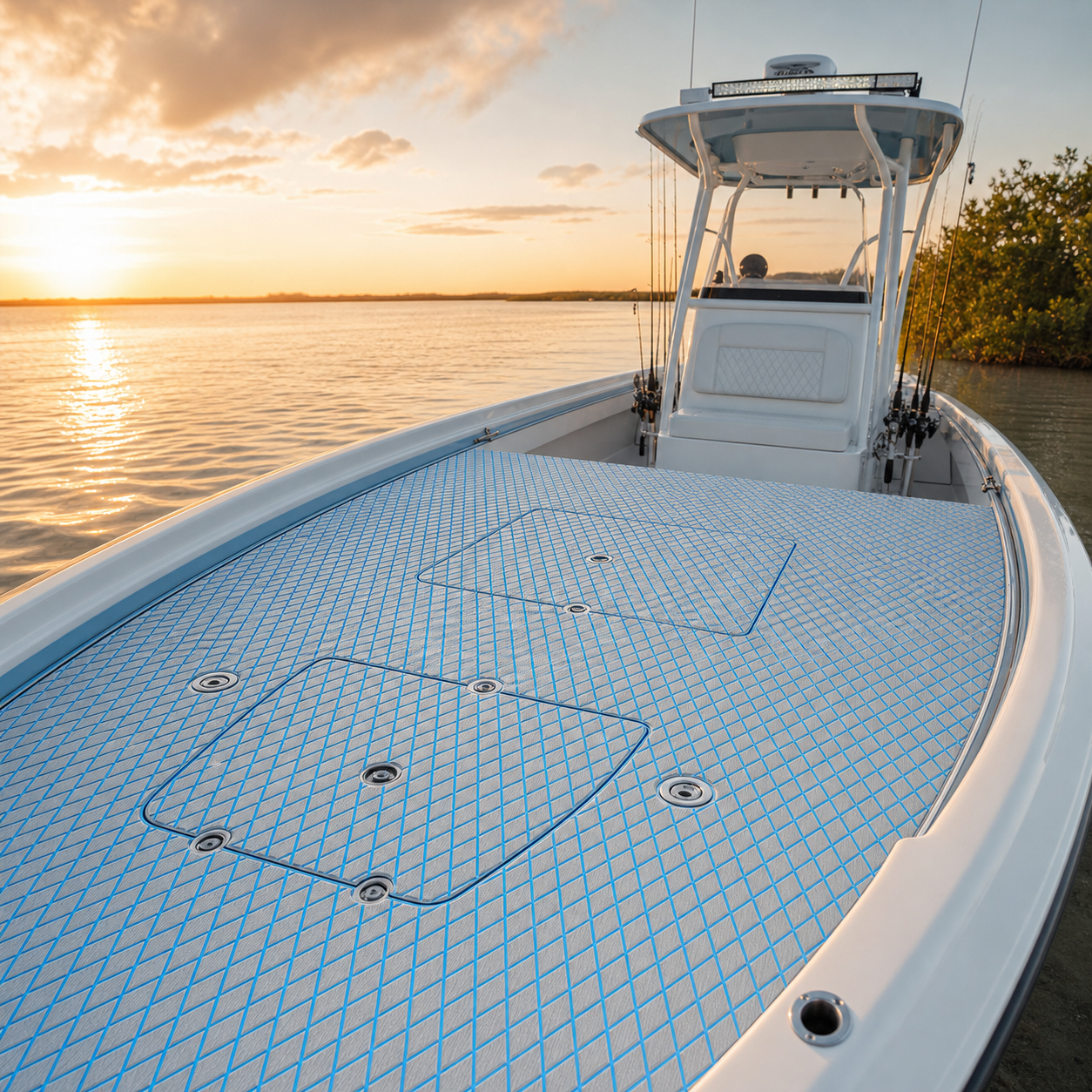
A flats boat puts a surprising amount of responsibility on a relatively open deck. Anglers need room to cast, move around a console, reach storage, handle gear, and step aboard without turning every trip into an obstacle course. The boat may also have broad hatch lids and molded channels that need to remain usable after any flooring upgrade.
Choosing boat flooring for flats boats therefore starts with the deck plan, not a color chart. A good buying process considers how the boat is used, where water travels, which panels move, and how the surface will be cleaned. This guide walks through those decisions without assuming that one material or layout suits every boat.
Define the fishing routine before comparing flooring
Begin with a normal day on the water. Note where an angler stands while casting from the bow, how a second person moves past the console, where a cooler or tackle bag sits, and which route people use when boarding. Add the areas used for poling, managing an anchor, landing a fish, or accessing livewells and storage.
Turn those observations into a simple deck map. Mark high-use paths, standing zones, hatch lids, drains, cleats, seat bases, fasteners, and removable equipment. The map helps you judge whether a proposed flooring layout supports the boat or merely decorates it.
It also reveals where separate panels may be useful. One uninterrupted sheet can look tidy in a rendering, but a hatch or service cover still needs to open, lift, and return to place. Let functional boundaries guide the panel boundaries.
Look closely at the existing deck
Flooring is only one part of the system. Inspect the deck underneath before choosing a product. Look for loose coating, cracks, repairs, residue, soft areas, persistent moisture, or hardware that may need service. An upgrade should not be used to hide a condition that deserves inspection.
Identify the actual surface material and finish. A smooth molded deck, painted surface, textured nonskid area, aluminum panel, or previously covered deck may require different preparation and compatibility checks. Ask the supplier what substrate information is needed for the exact option you are considering.
Observe drainage after a routine rinse. Watch where water collects, crosses a hatch seam, or runs toward a channel. Any new panel should preserve the intended route and keep drains clear. Avoid drawing borders or narrow filler pieces across places that regularly carry water.
Compare surface feel in realistic conditions
Flats-boat anglers often stand for long periods and change direction while casting or working around gear. Texture matters, but no surface should be treated as slip-proof. Water, sunscreen, fish residue, mud, wear, footwear, and cleaning products can all affect traction.
When evaluating a textured or traction-focused surface, compare it under conditions that resemble your use. Consider how it feels with the footwear normally worn aboard and how easily visible grooves can be reached during cleaning. A dramatic pattern may create a strong visual identity, while a subtler texture may be easier to coordinate with the boat. Neither appearance alone establishes performance.
If you are comparing EVA foam boat flooring, confirm the exact surface texture, backing, thickness, deck compatibility, care guidance, and current terms for the selected SKU. Do not rely on a generic category description to represent every product.
Balance color, glare, and the rest of the boat
A flooring sample occupies only a small area, while the finished deck may fill most of the view from the console. Compare colors beside the gelcoat, upholstery, console, trim, and hardware. View them outdoors in direct light, shade, and evening light rather than judging them only on a screen.
Contrast changes how a pattern reads. Dark outlines can emphasize panel geometry and hatch alignment; lower-contrast combinations can create a quieter field. Consider how sand, dock dirt, fishing residue, and rinse water may appear on the colors you prefer. This is a practical appearance and maintenance choice, not a universal rule that one shade works for every flats boat.
Pattern direction also affects the overall impression. Lines running fore and aft may reinforce the boat's length, while crosswise lines emphasize width. Diamond patterns can feel more neutral, but they still need a clear centerline and consistent orientation across adjacent panels.
Protect access to every hatch and service point
Open casting decks often contain more access points than they first appear to. Check storage lids, livewells, fuel access, batteries, pumps, wiring covers, pedestal sockets, and fasteners. Open every hatch fully during planning and note where hinges, latches, and fingers need clearance.
A removable hatch panel should remain easy to identify. Continuing a pattern across the lid can look polished, but visual continuity should never conceal the edge or make servicing awkward. Use consistent margins around frames and hardware so the layout feels deliberate without interfering with movement.
Pay attention to small fittings. A panel cut too close to a cleat or drain can look cramped, while an unexplained large gap can make the design feel unfinished. Establish a margin approach, then adjust only where the deck's geometry or service needs require it.
Decide between a stock layout and a custom template
A stock or pre-cut option may be convenient when it is designed for the exact boat configuration and the deck has not been altered. Boat model names alone are not enough. Consoles, hatches, seating, rigging, and owner modifications can change the usable layout.
For custom boat flooring, a full-size template communicates curves, tapers, cutouts, and panel relationships. Use stable material that lies flat and holds its shape. Label every section with the bow direction, top side, location, pattern direction, and neighboring pieces. Photograph the template in place before removing it.
Check a template by walking the deck and operating everything around it. Confirm that:
- all hatches open and removable panels can be lifted;
- drains, cleats, sockets, and service fasteners remain accessible;
- panel margins look consistent from normal standing positions;
- the boarding path and casting areas are free of awkward seams;
- the pattern direction is marked on every separate piece;
- joined template sections cannot shift before measurement or scanning.
Measurements are useful as cross-checks, but a few length-and-width figures cannot fully describe a molded curve. Keep the marked master template, overview photos, close-up photos, and final drawing together until the project is complete.
Plan installation and future maintenance together
Ask how the selected flooring is installed and what preparation the exact deck surface needs. Confirm who is responsible for final dimensions, how the design proof represents cut lines, and what should happen around seams and edges. If professional installation is being considered, verify the installer's scope directly.
Think beyond the first day. A flats boat may collect fine sand, plant debris, fishing residue, and dirt from shallow-water access points. Look at the groove pattern and panel edges from a cleaning perspective. Can routine debris be reached without dismantling hardware? Are there tight pockets beside the console or hatch frames?
Use only care methods appropriate for the exact surface. Remove loose debris before scrubbing, rinse away residue, and test unfamiliar cleaners in an inconspicuous area according to the supplier's guidance. Inspect seams, edges, and access panels during normal cleaning so small changes are noticed early.
Use a buyer's checklist instead of a single headline claim
A useful comparison records the same information for every candidate. Create a short table or note with the exact product name, surface texture, color, backing, thickness, substrate compatibility, template process, installation method, care instructions, current availability, and current commercial terms. Leave a field blank when the supplier has not confirmed it.
Then compare each option against the deck map created at the start. A material may look excellent but be a poor match for a particular hatch arrangement or preparation requirement. Another may fit the functional plan but need a different color or panel direction. Buying decisions become clearer when appearance, fit, access, installation, and upkeep are reviewed separately.
If Focean is on your shortlist, treat it as one option in that same structured comparison. Confirm the exact specifications, compatibility, template requirements, care guidance, availability, and terms for the product being evaluated rather than assuming that general information applies to every selection.
Practical takeaway: perform a five-action deck test
Before approving a flooring order, place the proposed panel boundaries on the deck with removable tape or paper. Then perform five actions: board the boat, walk around the console, cast from the bow, open every hatch, and rinse the deck. Watch for obstructed access, awkward seams, trapped water, and inconsistent margins.
This simple rehearsal connects the design to actual use. Photograph the layout from the dock, helm, bow, and stern, then make final corrections on the template or drawing before any material is cut.
Frequently asked questions
Is EVA foam suitable for every flats boat?
No flooring category should be assumed to fit every boat. Suitability depends on the exact product, deck substrate and condition, layout, preparation, installation method, exposure, and care routine. Confirm those factors for the selected SKU and boat.
Should flooring cover the entire casting deck?
Not automatically. Hatches, drainage paths, hardware, service areas, and panel handling may favor several coordinated sections. Coverage should follow functional deck boundaries while preserving access and water flow.
How do I choose a pattern direction?
Choose one dominant axis based on the boat's geometry, then test it from normal boarding and standing views. Keep the direction consistent across nearby panels where practical, while clearly preserving hatch edges and service access.
What should I confirm before ordering?
Confirm the exact product and color, surface texture, backing, thickness, substrate compatibility, template format, installation guidance, care instructions, current availability, current terms, and who is responsible for checking scale and dimensions.
Ready to compare your options? Map the deck first, test every hatch and drainage route, then compare Focean with the same exact-product checklist you use for any flooring candidate.
Share:
Custom Boat Flooring for Sport-Fishing Cockpits: A Design Guide
How to Clean Boat Flooring on a RIB: A Practical Care Guide