
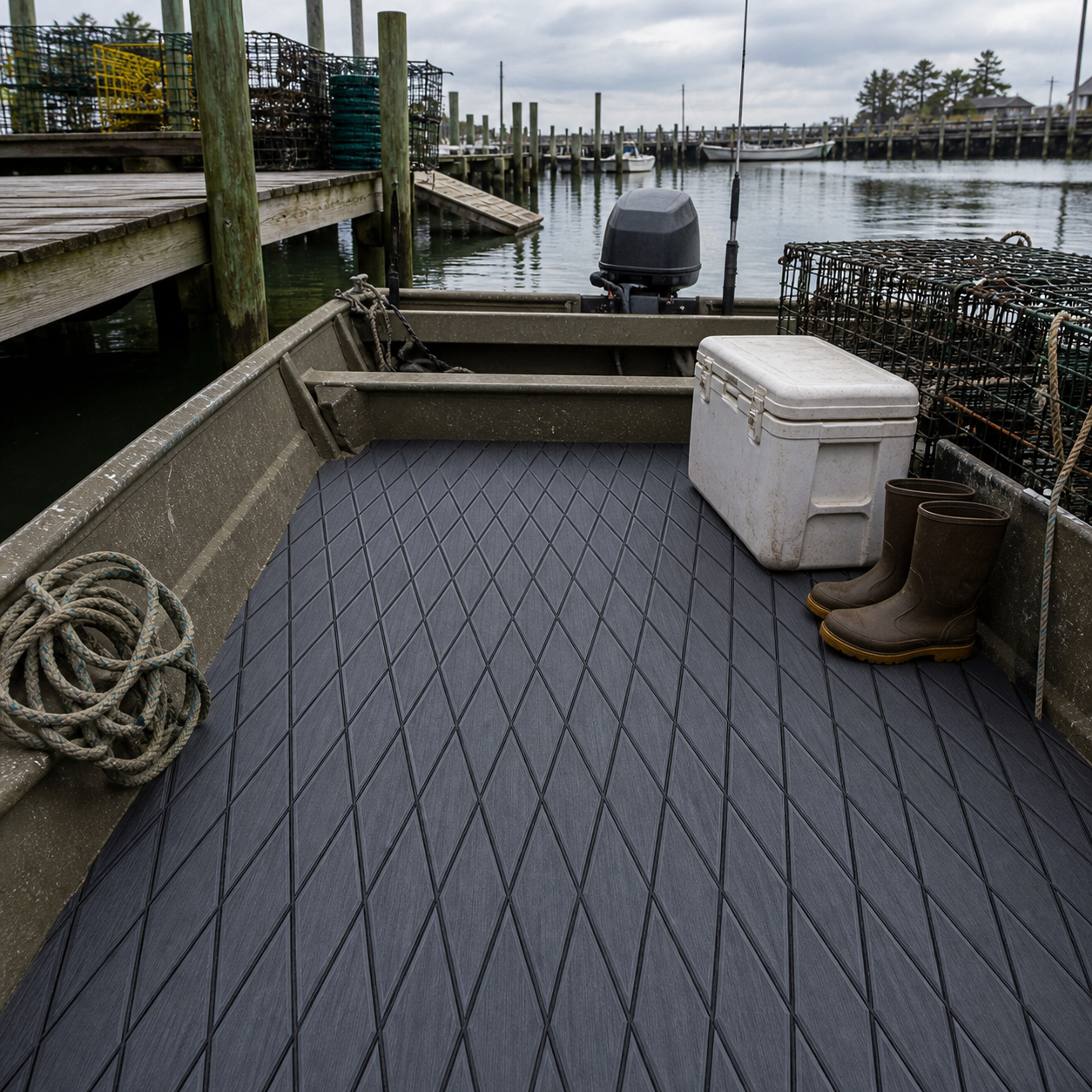
A skiff earns its keep in shallow water, at working docks, and on fishing days when mud, spray, bait, rope, and coolers all compete for deck space. That makes flooring a practical decision rather than a purely decorative one. Two common directions are EVA foam panels and marine vinyl sheet flooring. Both can create a finished walking surface, but they behave differently around hatches, seams, cleaning, repairs, and deck preparation.
This guide compares EVA foam vs. marine vinyl flooring for skiffs without pretending that one material wins in every boat. The right choice depends on the substrate, how the skiff is used, where it is stored, and whether the owner values cushioning, a continuous surface, easy panel replacement, or a particular installation method.
Quick answer: EVA foam or marine vinyl?
EVA foam is often appealing when an owner wants a cushioned, textured surface that can be divided into fitted panels around hatches and work zones. Marine vinyl can make sense when a durable-looking, low-profile sheet surface and broad visual continuity are more important, especially on a simple deck that can accept carefully planned seams and edge treatment.
Neither choice fixes a soft floor, loose fasteners, corrosion, trapped moisture, or failing plywood. Flooring is a finish layer. Inspect and repair the deck first, preserve drainage and service access, and confirm compatibility among the substrate, adhesive, and exact flooring product before installation.
What is EVA foam boat flooring?
EVA boat flooring is a foam surface supplied as sheets, pre-cut panels, or custom-shaped pieces. The visible face may use grooves, brushed texture, or a routed pattern. Pieces are commonly arranged around lids, benches, consoles, and other obstacles, giving the installer control over panel boundaries and pattern direction.
Products vary in construction, backing, texture, color, and installation requirements. Do not assume that every EVA sheet is intended for the same deck material or exposure. Review the current instructions for the item you are considering and test a small, discreet area when the supplier recommends it.
What is marine vinyl flooring?
Marine vinyl flooring is a flexible sheet covering made for boat interiors or exposed deck applications, depending on the product. Some versions have an embossed face that resembles woven material, wood grain, or another texture. It is typically bonded over a prepared substrate, with seams and perimeter edges planned to limit lifting and water intrusion.
“Marine vinyl” is a broad label. Wear layer, backing, texture, adhesive system, and suitability for an open skiff differ among products. Upholstery vinyl is not automatically deck flooring, and an interior-rated sheet should not be treated as an exterior surface without written confirmation from its manufacturer.
How the two materials differ on a working skiff
Comfort during long periods on deck
Foam adds a cushioned layer between the foot and the hard deck. Anglers who stand at the bow, guides who move around a center bench, or owners who kneel while handling gear may value that feel. The amount of support depends on the exact foam rather than the category name alone.
Marine vinyl is usually a thinner finish and tends to reflect more of the firmness of the deck below. It can still feel more refined than bare metal or painted plywood, but buyers who prioritize cushioning should compare physical samples instead of judging from photographs.
Wet footing and surface texture
Texture matters on either material. Routed or embossed foam and textured vinyl are designed to improve contact underfoot, but no surface should be treated as slip-proof. Water, fish residue, sunscreen, fuel or oil contamination, worn areas, and footwear can change traction quickly.
Look beyond an aggressive pattern. Consider whether the surface can be cleaned fully, whether grooves direct debris toward drains, and how the material feels with the footwear normally used aboard. Good deck habits still include clearing spills promptly and keeping walking paths free of loose gear.
Cleaning mud, scales, and dock debris
Both foam and vinyl avoid the deep pile of carpet, so loose hooks, line clippings, and grit are easier to see. A broad vinyl sheet can have fewer field joints, which may simplify sweeping and rinsing. Its embossed texture and seams can still collect residue, and harsh cleaners may affect the surface or adhesive.
EVA panels are also straightforward to inspect and spot-clean, but routed grooves and closely spaced panel edges deserve attention. Use only cleaning methods approved for the selected material. A soft brush and patient rinsing are generally safer starting points than a stiff tool, aggressive solvent, or high-pressure spray aimed at edges.
Seams, edges, and water paths
Marine vinyl may cover a large area with a continuous sheet, but a skiff rarely offers a perfect uninterrupted rectangle. Benches, hatches, pedestal bases, ribs, drains, and repair plates create cuts and transitions. Every seam and perimeter needs a deliberate termination that suits the product and substrate.
EVA is naturally planned as separate panels. This can help isolate hatches and service zones, yet it also creates more visible edges. Panel spacing should be consistent, and edges should not block drainage or sit where boots, coolers, traps, or rope repeatedly drag across them.
Hatches and future access
A small skiff often hides important systems beneath a simple-looking floor. Batteries, pumps, wiring, fasteners, fuel components, inspection ports, and drain paths may need future access. Flooring should make those boundaries clearer, not conceal them.
Foam panels can be shaped to separate a hatch lid from its frame. Vinyl can also be fitted to removable lids, but wrapping, trimming, and clearance need careful planning. Open every hatch during the dry fit. Check hinges, latches, gutters, and the full swing before any adhesive is applied.
Repair strategy
Damage on a working boat is realistic. A trap corner, knife point, battery box, anchor, or dragged cooler can mark either surface. With EVA, a panel-based layout may allow one damaged zone to be remade, although color and pattern matching can become harder as surrounding material ages.
A local vinyl repair may be visually noticeable, while replacing a large sheet can require removing more hardware and edge work. Before choosing, ask how repairs are performed and whether you can keep labeled offcuts from the original installation for future patches or small replacement pieces.
Appearance on simple utility decks
Vinyl can create a calm, continuous field that visually simplifies a plain plywood deck. It suits owners who prefer a flatter finish with fewer panel outlines. EVA can emphasize the deck layout through routed borders, contrasting grooves, and individually fitted zones.
Choose for the boat rather than for a catalog close-up. Dark colors may show dust differently and can feel warmer in direct sun, while very light colors may reveal stains sooner. View samples outdoors and beside the hull, seating, and hardware before committing.
Installation questions that matter more than the label
The quality of the substrate and installation often matters more than the material category. Start by identifying whether the deck is aluminum, fiberglass, coated plywood, or another surface. Remove failing finishes and old adhesive using methods appropriate for that substrate. Repair flexing panels, raised fasteners, corrosion, cracks, and leaks before covering them.
Next, map the entire deck. Mark drains, ribs, hatches, inspection points, seat bases, fuel-system access, and removable hardware. Decide where seams can sit without becoming trip points or high-wear edges. Establish a reliable centerline or another fixed reference so patterns do not drift from bow to stern.
Make full-size templates for irregular zones and label each one with its top face and bow direction. Dry-fit every piece or sheet section together. A single part can look accurate while shifting the neighboring seam or restricting a hatch. Keep release liners in place until the complete layout has been checked.
Finally, follow the current preparation and bonding instructions for the chosen system. Do not improvise with an unapproved solvent, adhesive, sealant, or cure schedule. If the project requires disconnecting steering, electrical, fuel, or structural components, use a qualified marine professional.
Choose EVA foam when these priorities lead
- You value cushioning during long periods of standing or kneeling.
- You want distinct fitted zones around hatches and work areas.
- You prefer a routed or patterned deck appearance.
- You want a panel-based repair plan for high-wear locations.
- You are prepared to template carefully and protect exposed edges.
Choose marine vinyl when these priorities lead
- You prefer a thin, broad sheet surface with visual continuity.
- The skiff has a simple, stable deck with manageable transitions.
- You are comfortable planning seams and perimeter terminations precisely.
- Cushioning is less important than a flatter finished profile.
- The exact vinyl is documented for the boat area and exposure you have in mind.
FAQ about skiff flooring
Can either material go over old carpet or failing flooring?
Do not bond a new finish over carpet, loose material, residue, or a moving surface. Remove the old covering, inspect the substrate, and prepare it for the exact system being installed. Covering a problem makes later diagnosis harder.
Which option is easier to keep clean?
Both can be easier to inspect than a fibrous floor, but layout and texture influence the result. A continuous vinyl area may have fewer seams, while foam panels can make individual work zones easy to identify. Compare how samples release dried mud and common fishing residue using approved cleaners.
Can I install flooring over an aluminum skiff deck?
Possibly, if the flooring and bonding system are compatible with the prepared metal or coating. Aluminum movement, corrosion, existing paint, temperature, drainage, and removable panels all need consideration. Use written product guidance rather than a general category assumption.
Which material lasts longer?
There is no responsible universal answer. Exposure, storage, substrate movement, installation quality, cleaning habits, traffic, and the exact product all affect service life. Compare current written specifications and care instructions for the items under consideration.
Practical takeaway
For a skiff, EVA foam is the stronger candidate when cushioning, fitted panels, and a textured visual design lead the decision. Marine vinyl is worth considering when a lower-profile continuous sheet and fewer field joints suit the deck. The winning material is the one that matches the substrate, preserves access and drainage, and fits the way the boat is actually worked and cleaned.
Focean is one place to review current EVA foam flooring information while you compare materials. Confirm the backing, dimensions, substrate compatibility, care guidance, and current terms for the exact item before ordering or cutting.
Planning a skiff deck refresh? Visit Focean to compare current flooring information, then build a deck map and sample-test your shortlisted materials before choosing a full layout.
Share:
How to Plan an EVA Foam Flooring Installation for a Center Console
How to Choose Comfortable Pontoon Boat Flooring for Busy Decks