
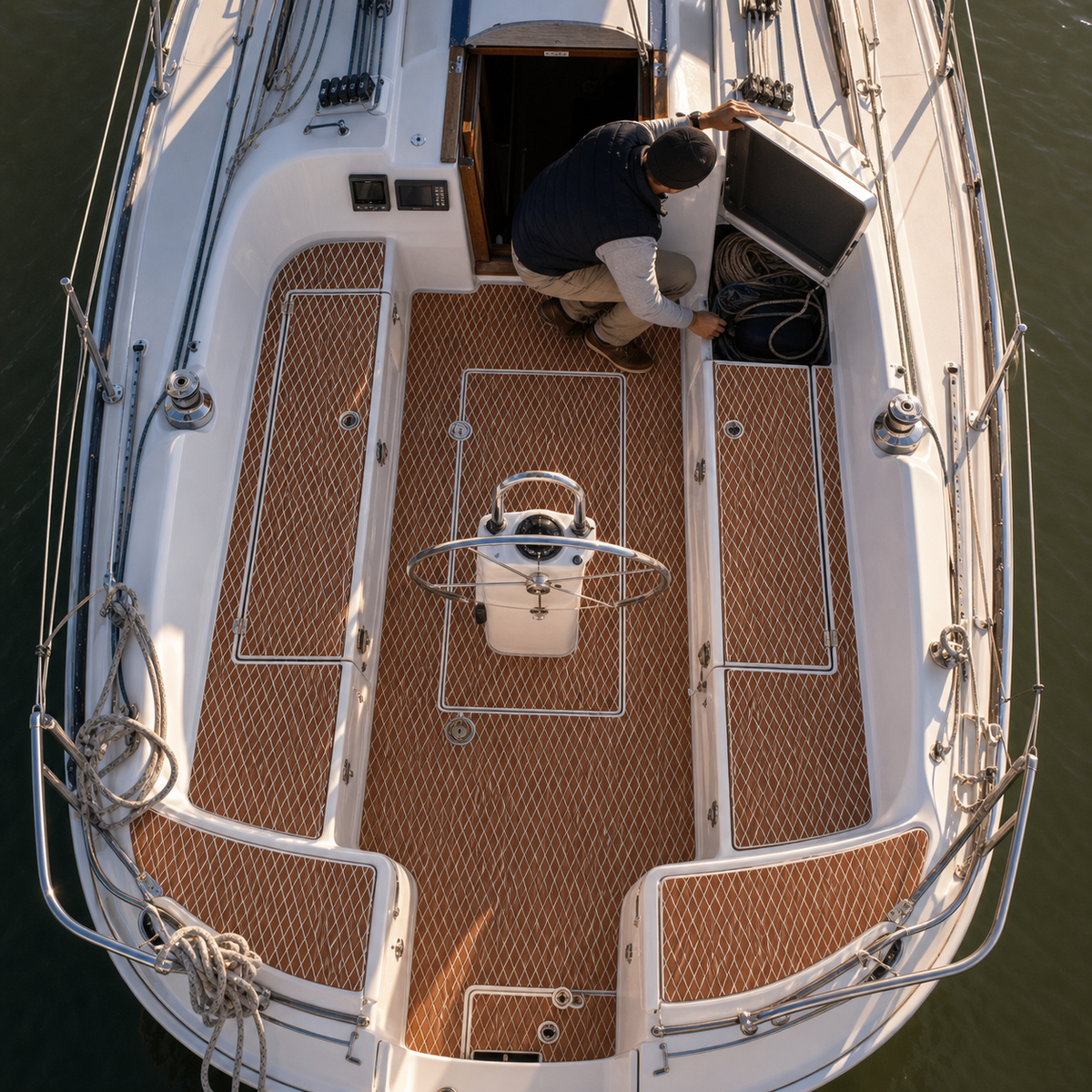
A sailboat cockpit is more than a place to sit. It is a working area for steering, trimming lines, opening lockers, boarding, and moving between the companionway and side decks. Flooring choices therefore need to support the cockpit’s layout without hiding drainage, restricting access, or complicating routine care.
Two common directions are EVA foam flooring and marine carpet. Neither is automatically right for every sailboat. Cockpit shape, substrate, drainage, climate, storage, footwear, maintenance habits, and the exact product all matter. This guide compares the decisions behind both materials so you can build a shortlist around your boat rather than a generic winner.
Begin with the cockpit, not the material
Before comparing samples or colors, map the cockpit as it exists. Mark the helm, pedestal, wheel or tiller sweep, drains, scuppers, locker lids, hinges, latches, inspection ports, fuel or water fills, shore-power connections, traveler hardware, winches, cleats, and removable service panels. Include the companionway step and any passage used to reach the side deck.
Open every locker and move every control through its normal range. Flooring must not block a drain, reduce a required gap, conceal a fastener, or make emergency and maintenance access harder. If a fitting is unfamiliar, identify it from the boat documentation or ask a qualified marine technician before planning around it.
Then record the current surface. Is it molded fiberglass, paint, a removable insert, an older bonded covering, wood, or a repaired area? Look for wax, polish, sealant, old adhesive, cracks, soft spots, moisture, and uneven transitions. The substrate and its condition may eliminate an otherwise appealing option.
EVA foam and marine carpet: the practical difference
EVA foam flooring is generally supplied as fitted panels, sheets, or pieces with a textured surface. Marine carpet is generally a textile covering installed as removable sections or bonded pieces, depending on the product and boat. Those broad categories contain many constructions, so confirm the exact backing, edge treatment, intended substrate, and installation instructions for any candidate.
The most useful comparison is not “Which material is best?” but “How will this exact system behave in my cockpit?” Focus on six areas: water management, locker access, cleaning routine, comfort, visual layout, and installation risk.
1. Water management and drainage
A sailboat cockpit regularly encounters spray, rain, wet footwear, and wash water. Start by tracing where water enters and how it reaches the drains. Any flooring layout should preserve those paths and keep drain openings visible and serviceable.
With EVA foam, examine panel edges, seams, hatch borders, and the spaces around hardware. Ask how the selected product should terminate near a drain and whether its instructions permit the intended exposure. Do not assume that a category name establishes waterproofing, saltwater performance, or edge behavior.
With marine carpet, check how the exact construction handles wetting, drying, removal, and cleaning. A removable section may allow inspection beneath it, while a bonded installation creates different preparation and access questions. Confirm whether the carpet can be lifted, how edges are finished, and what the manufacturer requires after it becomes wet.
For either material, avoid covering a low point, drain channel, or hidden access route. After dry fitting, test drainage only in a way approved by the boat builder and product instructions.
2. Lockers, hatches, and working hardware
Sailboat cockpits often concentrate moving parts in a small area. A locker lid may swing past a seat edge, a latch may sit nearly flush, and a pedestal access panel may need regular removal. Material thickness, edge position, and panel layout can affect whether those parts still work correctly.
EVA foam is often planned as multiple shaped panels. That can make it possible to outline individual lids and service areas, but only a full template and dry fit will show whether the clearances are correct. Directional patterns also need to align across neighboring pieces without disguising the boundary of a removable panel.
Marine carpet layouts may use a larger removable section or separately finished pieces. Check whether the material can shift near controls, bunch at a threshold, catch on a hinge, or obstruct a latch. If it is bonded, treat each access opening as a deliberate cutout rather than covering the cockpit first and searching for hardware later.
3. Cleaning and inspection routines
Choose the routine you will realistically follow. Think about sunscreen, food, fish residue, dock dirt, leaves, line fibers, and ordinary harbor grime. Review the cleaning products, tools, rinsing method, and drying conditions allowed for each exact product. Avoid assuming that a familiar household cleaner is suitable.
A textured EVA surface may call for attention along grooves, seams, edges, and hardware cutouts. Carpet may require attention within the pile, underneath removable sections, and at finished borders. The relevant question is not which looks cleaner in a sample photo, but whether you can inspect and care for the entire installed system.
Build an inspection step into routine cleaning. Look for lifted or damaged edges, trapped debris, moisture where it should not remain, blocked drains, loose fasteners, and changes around high-traffic transitions. Follow the product maker’s repair or replacement guidance rather than improvising with an unapproved adhesive or coating.
4. Comfort, movement, and traction
Cockpit flooring affects how the deck feels under bare feet, deck shoes, and knees during line handling or locker access. Compare physical samples in realistic conditions when possible, but do not treat a small sample as proof of whole-cockpit performance.
Texture can support a traction-focused design, yet no flooring makes a wet cockpit slip-proof. Water, algae, sunscreen, fish residue, wear, footwear, heel angle, and cleaning condition all influence footing. Keep the cockpit clean, use appropriate footwear, maintain handholds, and follow safe boating practices regardless of material.
Also consider where people pivot or brace: at the helm, beside the companionway, near winches, and during boarding. Panel seams, carpet edges, thresholds, and transitions should not create avoidable trip or catch points. Evaluate the complete layout, not only the center of a panel.
5. Visual fit and cockpit character
Flooring occupies a large visual area in the cockpit. EVA foam can create defined panels and directional patterns; marine carpet can create a softer, more continuous field. Either can look disorganized when seams ignore the boat’s centerline, locker geometry, or hardware.
Photograph the cockpit from the helm, companionway, dock, and overhead if practical. Use those views to plan pattern direction, seam positions, color relationships, and panel borders. Keep the design subordinate to access and drainage. A visually continuous line should never disguise a hatch or encourage flooring to cross a service boundary.
Remember that digital colors vary. Review a physical sample in the cockpit’s daylight and shade when available, and confirm the selected SKU before ordering. If samples would help, contact the supplier to ask whether they are currently available rather than assuming they are offered.
6. Installation approach and reversibility
The installation method may be the deciding factor. Some products are removable; others are intended to remain bonded. Ask what preparation is required, what conditions are acceptable during installation, how curves and edges are handled, and what removal could mean for the underlying surface.
For EVA foam, create labeled templates for each zone and mark bow, stern, port, starboard, and pattern direction. Transfer those templates only according to the supplier’s directions. Dry-fit every piece with backing intact, then operate lockers, controls, latches, and drains before installation.
For carpet, confirm whether the exact product is designed for removable or bonded use in the intended location. Dry-fit around the helm, companionway, seat bases, and locker openings. Check edge finishing and movement underfoot. Do not use the old covering as unquestioned proof of the new layout; verify every dimension against the actual cockpit.
If surface preparation, cutting, bonding, or removal is outside your experience, use a qualified installer. General guides cannot replace the instructions for the exact boat, material, and adhesive system.
A cockpit comparison checklist
- Substrate: Is the exact product approved for the current surface and coating?
- Drainage: Will drains, channels, and low points remain open and inspectable?
- Access: Can every locker, latch, fastener, and service panel still operate?
- Controls: Is the wheel, tiller, pedal, traveler, and companionway path clear?
- Care: Can you follow the required cleaning, drying, and inspection routine?
- Layout: Do seams and pattern direction support the cockpit geometry?
- Installation: Can the specified preparation and fitting method be completed correctly?
- Removal: Do you understand how future repair or replacement may affect the substrate?
Practical takeaway: choose through a full dry fit
Use the cockpit map to narrow the material choice, then build a complete template or dry-fit plan before committing. Compare how each option handles the same real constraints: drains, locker movement, helm access, companionway traffic, cleaning, and future inspection. The better choice is the system whose exact instructions and layout fit your boat and your maintenance habits.
When discussing the project with Focean or another supplier, bring clear cockpit photographs, substrate details, labeled dimensions, and a list of every hatch and drain. Ask for current product-specific compatibility, installation, care, and terms before ordering.
Frequently asked questions
Is EVA foam automatically better than marine carpet in a wet cockpit?
No universal answer applies. Construction, backing, edge treatment, drainage layout, installation, and maintenance differ by product and boat. Compare the exact systems against your cockpit map and follow their current instructions.
Can flooring cover cockpit locker lids?
It may be possible when the product instructions allow it and the lid remains fully visible, operable, removable, and clear of hinges and latches. Template the lid as a separate access zone and test its full movement during the dry fit.
Should I remove existing cockpit carpet before evaluating EVA foam?
Inspect the underlying surface before deciding. Existing carpet can hide adhesive, coatings, repairs, moisture, or surface variation. Use boat- and product-specific removal guidance, especially when the condition underneath is uncertain.
How should I compare colors and textures?
Review physical samples in the cockpit’s typical light when available. Check the feel with suitable footwear, but remember that a sample does not prove installed performance. Confirm the exact SKU, backing, care instructions, and current terms before purchase.
Planning a sailboat cockpit upgrade? Map every drain and access point, compare exact product instructions, complete a full dry fit, and contact Focean with your cockpit details to discuss current options.
Share:
How to Install EVA Foam Boat Flooring on a Runabout
Comfortable Boat Flooring for Aluminum Fishing Boats: A Practical Guide