
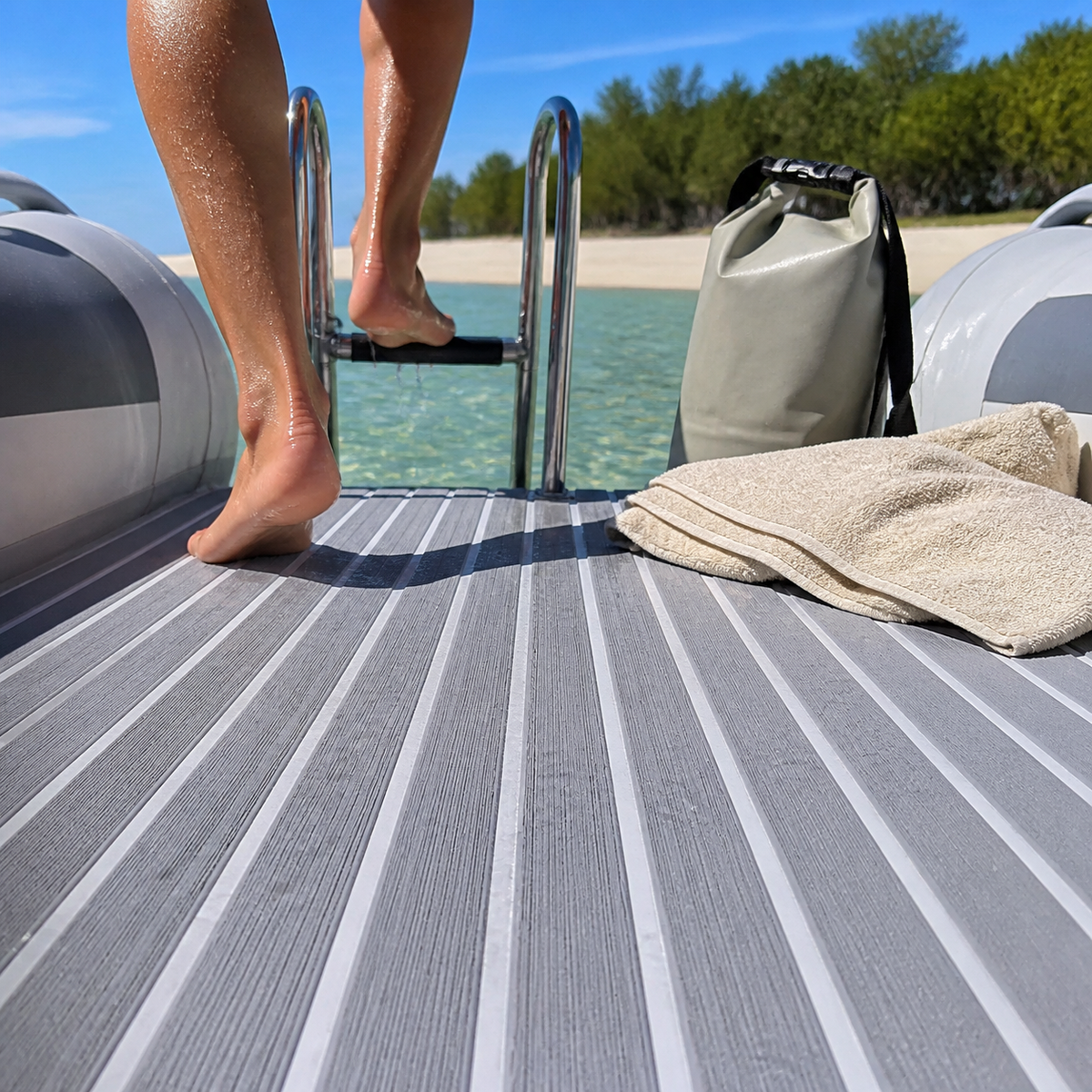
Choosing flooring for a rigid inflatable boat is not only a material question. A RIB compresses several jobs into a small deck: boarding from the water, moving around the console, handling bags or lines, opening lockers, and reaching the transom. The tubes, narrow walkways, removable equipment, and wet boarding edge can make a layout that works on a larger boat awkward here.
This guide compares EVA foam sheet flooring and marine vinyl as planning options for a RIB cockpit and boarding zones. It does not assume that one material is best for every boat. Instead, it shows how to compare the exact products you are considering against your deck shape, access needs, maintenance routine, and installation plan.
Begin with the RIB, not the material label
Before comparing samples or product pages, draw a simple deck map. Mark the console, helm seat, fuel or battery access, lockers, deck drains, transom fittings, tube attachments, boarding ladder, removable tanks or bags, and every fastener that may need future service. Add the routes people actually use between the dock, water, helm, and bow.
This map prevents a common mistake: evaluating a surface in isolation. A comfortable sample may still be difficult to panel around a narrow locker. A visually clean roll may create an inconvenient seam near a drain. The useful question is not “Which material sounds better?” but “Which exact system fits these zones without hiding access or complicating normal use?”
Understand the two flooring formats
EVA foam boat flooring is commonly considered as cut panels or sheets with a textured face. Marine vinyl is commonly considered as a flexible covering supplied in a roll or sheet. Those descriptions are only starting points. Construction, backing, texture, care instructions, installation method, and compatible substrates can vary among products in either category.
Do not transfer a claim from one item to an entire material family. Obtain current documentation for the exact SKU and confirm how it is meant to be cut, joined, cleaned, placed, and removed. If a seller cannot explain the product's intended substrate or preparation method, pause the project rather than filling in the missing details yourself.
Compare panel planning around tubes and narrow edges
A RIB often has curved deck boundaries where the rigid floor approaches the inflatable tubes. Photograph and trace those edges carefully. With EVA foam sheets, you may plan separate shaped panels that follow the visible deck. With marine vinyl, you may plan a larger flexible section or several sections, depending on the product and the boat's geometry.
Neither approach removes the need for accurate templates. Check whether the proposed edge remains clear of tube fabric, valves, attachment points, rub rails, lifting hardware, and serviceable fasteners. Avoid inventing a tight fit based on a photograph alone. Full-size templates make it easier to judge curved edges and narrow strips before material is cut.
Judge the boarding zone separately
The water-entry area has a different job from the helm. Wet feet cross it, a ladder may fold or slide nearby, towels and bags may collect there, and the edge may be viewed from water level. Treat the ladder landing, transom step, or aft deck as its own comparison zone.
For each candidate material, inspect the actual texture while dry and wet under controlled conditions, following the supplier's guidance. Water, residue, wear, footwear, and cleaning products all affect footing, so no surface should be described as slip-proof. Also check whether seams, panel edges, and pattern direction remain easy to see when approaching from the ladder.
Focean's RIB flooring guide for changing weather provides a related checklist for wet zones, drainage, equipment access, and seasonal inspection.
Compare access to lockers, drains, and equipment
Open every locker and service panel on the deck map. Note hinge movement, finger pulls, latches, removable covers, drain channels, and the space needed to lift or slide a component. Then sketch how each flooring option would stop at or continue across those boundaries.
Separate EVA foam inserts can make a panel map visually explicit, but each insert still needs correct clearance and orientation. A marine vinyl layout may use broader sections, but it must not disguise a moving boundary or cover a service point. The exact installation system determines what is practical. The final plan should keep every drain, fastener, label, and inspection opening recognizable.
Evaluate seams by movement, not just appearance
RIB occupants often pivot in confined spaces. They may step around a console, kneel beside a locker, move a cooler, or pass gear from a dock. Mark those movements on the deck map, then examine where each material plan places seams and edges.
A neat drawing can still put a narrow strip in a busy route. Shift proposed boundaries toward existing molded breaks, furniture bases, or low-traffic transitions when the exact product instructions allow it. Avoid using tiny offcuts simply to reduce waste. A coherent panel or sheet plan is easier to inspect later and less likely to confuse a removable insert with a fixed surface.
Compare care routines using real debris
List what actually reaches your RIB deck: sand, mud, fish residue, sunscreen, leaves, dock dust, or spilled drinks. Compare the current care instructions for each exact flooring product against that list. Ask which tools and cleaners are permitted, how grooves or seams should be handled, and what must be avoided.
Use a sample or approved offcut for a controlled cleaning check rather than experimenting on the installed deck. Observe how debris collects around texture, edges, and transitions. Also consider whether the layout lets rinse water reach the boat's intended drains without creating hidden pockets. For a practical routine, see Focean's RIB boat-flooring care guide.
Plan pattern and color at full scale
A small swatch cannot show how lines will run through a compact cockpit. Place full-size paper strips or temporary pattern markers on the deck. View them from the dock, helm, bow, and boarding ladder. Check whether the direction helps organize the space or makes hatches and narrow walkways look misaligned.
Light and dark surfaces can also look different beside tube fabric, console fiberglass, seating, and gear. Judge physical samples in the boat's normal daylight and shade rather than relying only on a screen. Keep this as a visual decision; do not infer temperature, fade life, or durability from color alone.
Build a fair product-by-product comparison
Create one worksheet for the exact EVA foam option and one for the exact marine vinyl option. Use the same questions for both:
- What substrates and preparation steps does the supplier specify?
- How should curves, seams, edges, hatches, and drains be handled?
- Which cleaning products and tools are permitted?
- What conditions are required during placement and afterward?
- How are damaged or service-access sections addressed?
- Which current terms apply to the exact item being considered?
Record the source and date for every answer. Blank cells are not evidence that the options are equivalent; they are questions to resolve before ordering. This method keeps the decision tied to the RIB and the actual products rather than broad material stereotypes.
Dry-fit the complete layout before committing
Once one option appears suitable, build full-size labeled templates and dry-fit the entire layout according to the supplier's guidance. Mark forward direction, neighboring pieces, removable inserts, and pattern direction. Walk the normal routes, open all access points, operate the ladder, and move any equipment that routinely crosses the deck.
Stop if the dry fit hides a drain, conflicts with a hinge, creates a confusing step edge, approaches tube material incorrectly, or depends on an unsupported installation assumption. Revise the plan or ask the supplier for exact guidance. A pause at this stage is much easier to manage than a problem discovered after final placement.
FAQ
Is EVA foam always better than marine vinyl on a RIB?
No. Suitability depends on the exact products, deck construction, installation method, access layout, care routine, and how the RIB is used. Compare documented requirements and test the proposed layout rather than relying on a category-level claim.
Can I compare the materials using small samples?
Samples can help with color, texture, and controlled care checks, but they do not replace a full-size panel map and templates. A small piece cannot reveal seam placement, pattern direction, hatch clearance, or the geometry beside inflatable tubes.
Should flooring cover the whole rigid deck?
Not automatically. Keep drains, inspection points, labels, fasteners, moving boundaries, and service areas visible and accessible. The right coverage plan follows the boat's layout and the exact product instructions.
Practical takeaway
Choose between EVA foam and marine vinyl by comparing two complete systems on the same RIB deck map. Separate the boarding zone from the helm, preserve tubes and service boundaries, place seams around real movement, test care routines, and dry-fit every section. When considering a Focean option, confirm the exact sheet, backing, substrate guidance, preparation, placement, and care instructions for the item you are evaluating. For product-specific questions, contact Focean with clear deck photographs and a labeled zone map.
Share:
How to Plan EVA Foam Flooring Installation on a Cruising Catamaran
Traction-Focused Boat Flooring for Skiff Work and Boarding Zones